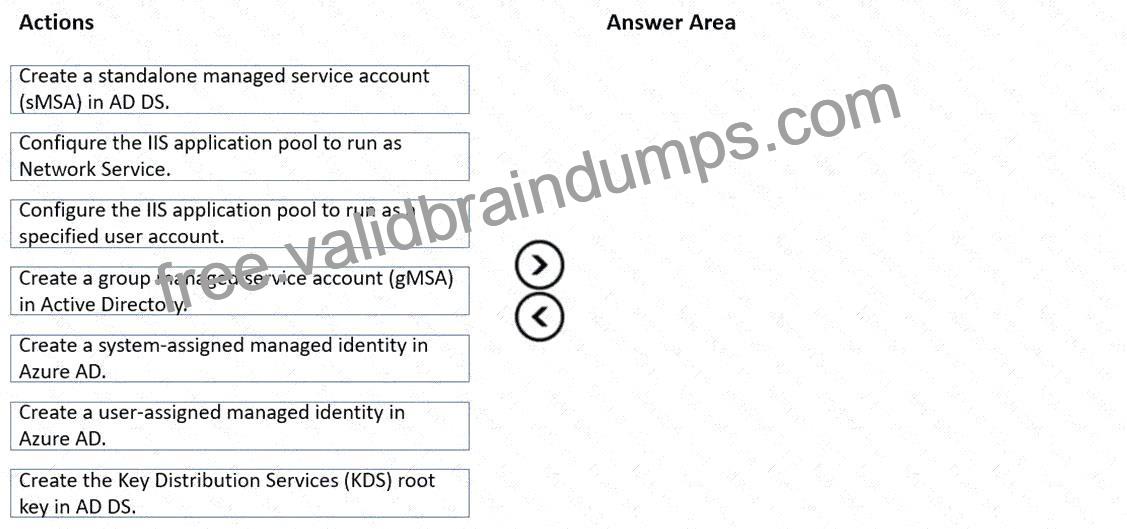
NO.112 Which three actions should you perform in sequence to meet the security requirements for Webapp1? To answer, move the appropriate actions from the list of actions to the answer area and arrange them in the correct order.
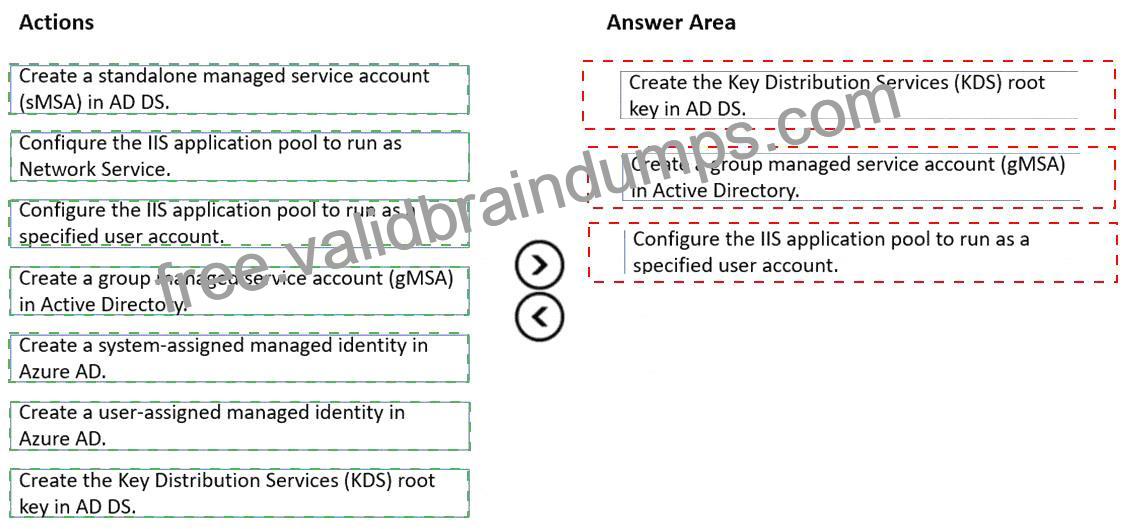
Explanation:
1. Create the KDS root key in AD DS. 2. Create a group managed service account (gMSA) in Active Directory. 3. Configure the IIS application pool (on WEB1 and WEB2) to run as the gMSA via a specified user account.
The requirement is that every instance of Webapp1 (running on both WEB1 and WEB2) uses the same identity, and that identity ‘ s password rotates automatically every 30 days, without any administrator manually resetting it. A standalone managed service account (sMSA) is tied to a single computer and cannot be shared across WEB1 and WEB2, so it does not meet the requirement. A group managed service account (gMSA) is designed exactly for this scenario: one AD-managed identity that multiple servers can use simultaneously, with the Key Distribution Service automatically rotating its password (by default every 30 days) without needing manual intervention or downtime. Before any gMSA can be created in the forest, a one- time prerequisite must exist: the KDS root key, which the Key Distribution Service uses to generate and later recompute the gMSA ‘ s password material. So the correct order is to first create the KDS root key, then create the gMSA object in Active Directory, and finally configure the IIS application pool on each web server to run as that gMSA using the ” specified user account ” identity option (entered as domain\gMSA$ with no password required, since the password is centrally managed). Creating a system- or user-assigned managed identity in Microsoft Entra ID does not apply here, since Webapp1 runs on IIS on domain-joined VMs, not as an Azure PaaS resource.
Topic 3, Case Study 3: A Datum CorporationThis is a case study.
Case studies are not timed separately. You can use as much exam
time as you would like to complete each case. However, there may be
additional case studies and sections on this exam. You must manage
your time to ensure that you are able to complete all questions
included on this exam in the time provided.
To answer the questions included in a case study, you will need to reference information that is provided in the case study. Case studies might contain exhibits and other resources that provide more information about the scenario that is described in the case study. Each question is independent of the other questions in this case study.
Overview: A Datum Corporation is a manufacturing company that has a main office in Seattle and two branch offices in Los Angeles and Montreal. A. Datum recently partnered with a company named Fabrikam, Inc. Fabrikam is a manufacturing company that has a main office in Boston and a branch office in Orlando.
Both companies intend to collaborate on several joint projects.
The on-premises network of A Datum contains an Active Directory Domain Services (AD DS) forest named adatum.com. The forest contains two domains named adatum.com and east.adatum.com, and the domain controllers shown in the exhibit below.
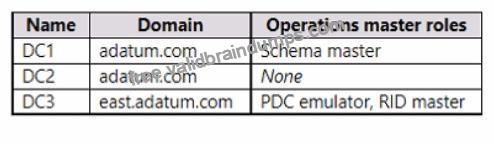
Domain controllers
The on-premises network of Fabrikam contains an AD DS forest named fabrikam.com. The forest contains two domains named fabrikam.com and south.fabrikam.com. The fabrikam.com domain contains an organizational unit (OU) named Marketing.
The adatum.com domain contains the servers shown in the exhibit below.
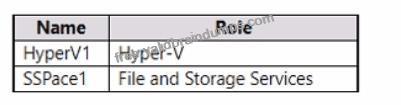
Servers
HyperV1 contains the virtual machines shown in the exhibit below. All the virtual machines on HyperV1 have only the default management tools installed.
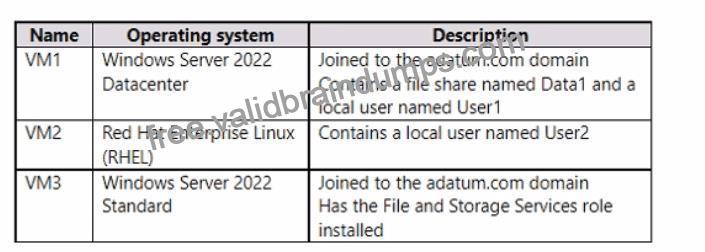
HyperV1 virtual machines
SSPace1 contains the Storage Spaces virtual disks shown in the exhibit below.

SSPace1 virtual disks
A Datum has an Azure subscription that contains a Microsoft Entra tenant. Microsoft Entra Connect is configured to sync the adatum.com forest with Microsoft Entra ID. The subscription contains the virtual networks shown in the exhibit below.
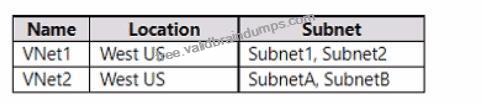
Virtual networks
The subscription contains the Azure private DNS zones shown in the exhibit below.
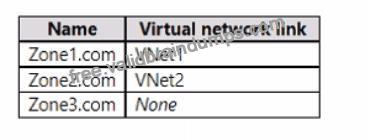
Private DNS zones
The subscription contains the virtual machines shown in the exhibit below. All the servers are in a workgroup.
The subscription contains a storage account named storage1 that has a file share named share1.
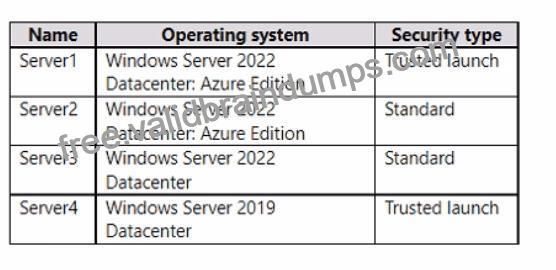
Azure virtual machines
Planned Changes: A Datum plans to implement the following changes:
– Sync Data1 to share1.
– Configure an Azure runbook named Task1.
– Enable Microsoft Entra users to sign in to Server1.
– Create an Azure DNS Private Resolver that has the following configuration: Name: Private1; Region: West US; Virtual network: VNet1; Inbound endpoint: SubnetB.
– Enable users in the adatum.com domain to access the resources in the south.fabrikam.com domain.
Technical Requirements: A Datum identifies the following technical requirements:
– The data on SSPace1 must be available always.
– DC2 must become the schema master if DC1 fails.
– VMs must be configured to enable per-folder quotas.
– Trusts must allow access to only the required resources.
– The users in the Marketing OU must have access to storage1.
– Azure Automanage must be used on all supported Azure virtual machines.
– A direct SSH session must be used to manage all the supported virtual machines on HyperV1.